Iguanas rarely climb a bare wall to reach your roof. They walk up a palm or an oak and cross an overhanging branch like a bridge. Cut the bridge and you cut the problem.
When a homeowner in Wellington or Coral Springs calls me about iguanas on the roof, the first thing I do is look up, not at the roof. Nine times out of ten there's a live oak, a ficus, or a clump of royal palms with limbs reaching over the roofline. That's the bridge. Iguanas are strong climbers with claws built for bark and trunk, and they'll take the easy route every time. A tall canopy that touches the house is the easy route.
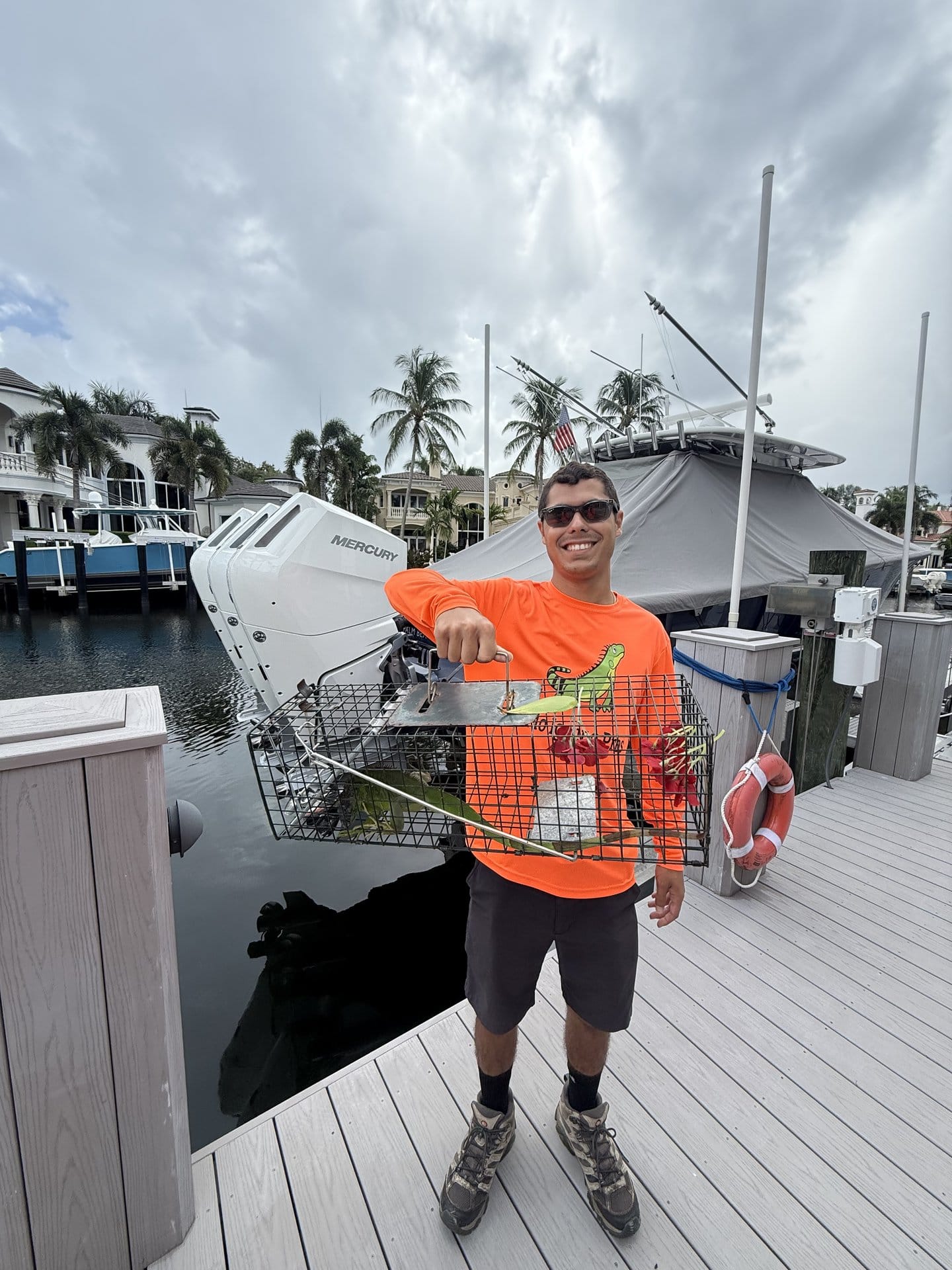
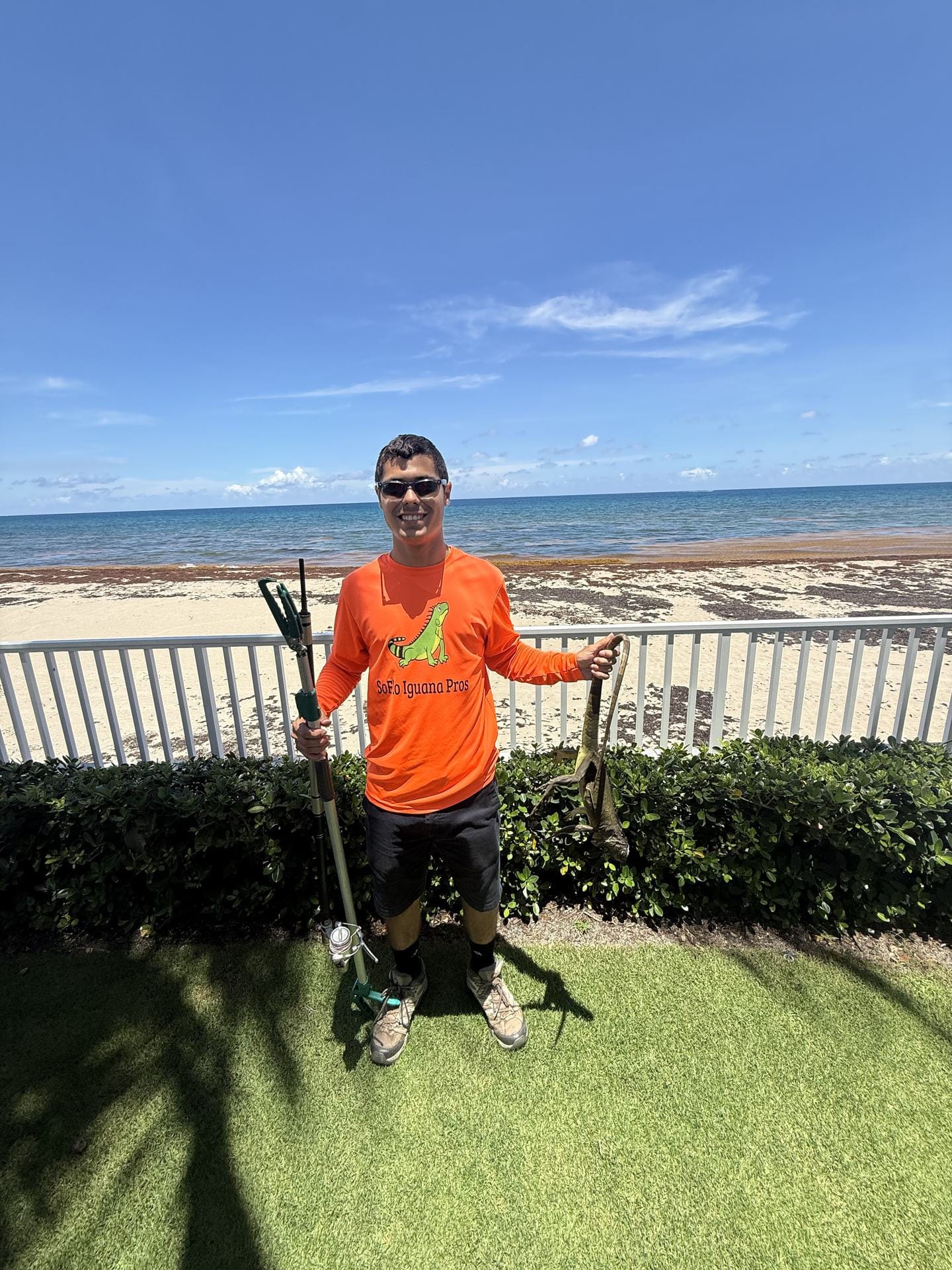
I'm Nick, and I run SoFlo Iguana Pros out of Lake Worth. I've walked hundreds of yards across Palm Beach County and Broward looking for exactly this, and the pattern holds. Iguanas don't scale stucco for fun. They climb what's already climbable and cross to the roof where the canopy hands them a path. Take that path away and most of the rooftop traffic stops.
How do iguanas get on my roof?
They climb up something with grip and cross over on something that touches the house. In South Florida that's usually a tree or a palm, but it's not the only route. Once you know what to look for, you can spot every one of them on a slow walk around the property.
Here's where I find the climb routes, roughly in order of how often they show up:
- Overhanging tree branches. Oaks, ficus, mango, and seagrape put out long horizontal limbs that reach over the roof. An iguana climbs the trunk and walks the branch onto the tile like a plank.
- Palms close to the house. Iguanas love palms. The rough trunk and old boot fronds give them grip, and a palm planted a few feet from the eave becomes a straight shot to the roof and gutter line.
- Fences and trellises tied to the wall. A wood fence, a lattice, or a trellis screwed to the house is a ladder. If it ends near the roof, so does the iguana.
- Downspouts and gutter corners. A downspout is a vertical pole with a wall right behind it. Iguanas shimmy these and pop out onto the gutter and then the roof.
- Pilings, pergolas, and pool cage frames. Anything vertical that touches or nearly touches the roof edge works. Screen cage top rails that meet the tile line are a common one on waterfront homes.
Why the roof is worth defending
People sometimes shrug at a couple of iguanas on the roof. It's not the sunbathing that costs you. It's what comes with it.
Droppings are the first headache. A large iguana leaves a lot of waste, and on a roof it washes into valleys, sits on tile, and stains the surface. It ends up in gutters and, on homes that catch rain, in the water. It's a mess to clean and it draws flies.
- Tile and flashing damage. Iguanas dislodge and crack barrel tile as they move and dig at loose edges. Cracked tile lets water in, and a small roof leak in our summer storms turns into a real bill fast.
- Attic and soffit entry. Where a branch drops an iguana near a torn soffit vent, a gap under the fascia, or a loose ridge, they'll push in for shelter. Once something is nesting in a soffit you've got a bigger problem than roof traffic.
- Pool cage access from above. Iguanas that reach the roof step down onto the top of an attached screen cage and work through any hole in the roof screen, so your enclosure gets hit too.
- Solar panels and rooftop equipment. Panels, condenser units, and vent stacks become basking spots and nest cover. Droppings on panels cut output, and burrowing near equipment causes its own damage.
How far should I trim branches back from the roof?
This is the question I get most, so I'll give you a real number. Aim to keep branches at least six feet back from the roofline. Iguanas can't jump a wide gap the way a squirrel can, so a clear span of open air stops them cold. Four feet helps, six is safer, and on tall canopy near an easy landing spot I go wider.
Trim to the trunk side of the limb, not just the tip. Cutting only the last foot leaves the iguana a slightly shorter branch, not a real gap. Take the limb back far enough that there's honest daylight between the branch and the eave, gutter, and tile edge. Check it from a few angles, because a limb that looks clear from the driveway can still overhang the back corner.
A few cautions. Palms are not trimmed like shade trees. Over-pruning a palm, cutting green fronds or the crown, hurts the tree and doesn't necessarily help you, since the trunk itself is the climb route. For palms the answer is usually a trunk wrap rather than a haircut. And in hurricane country, keep trees healthy and balanced rather than topping them, which creates weak regrowth. If a big oak or ficus needs serious work, get a licensed arborist on it.
Do tree wraps stop iguanas, and what about downspouts?
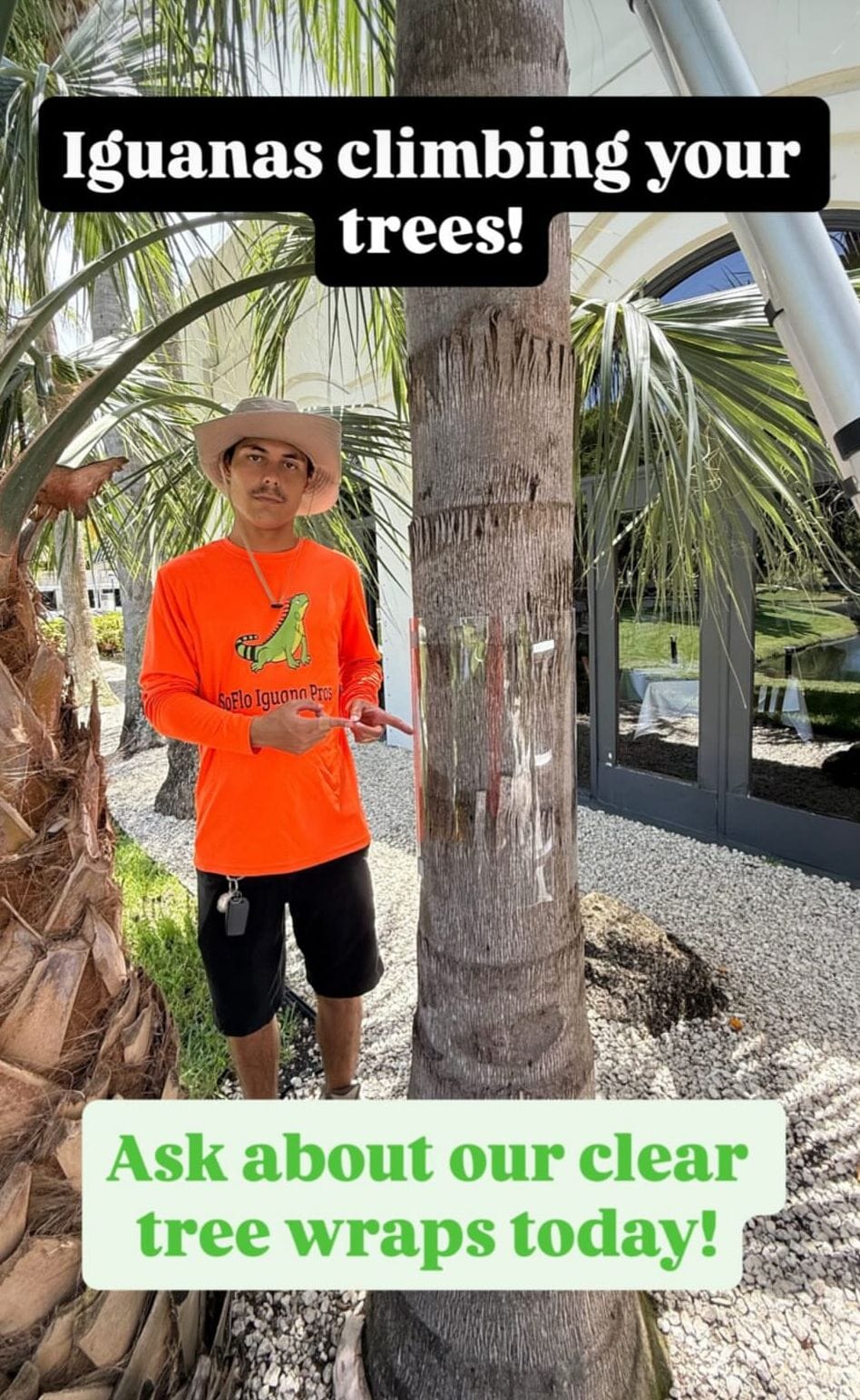
Sheet-metal trunk wraps can work on trees and palms, but only if they're done right, and fit is the part people get wrong. The idea is simple. You band a smooth collar of metal around the trunk so the iguana's claws find nothing to grip and it slides back down. The trouble is a wrap that's too short, too low, or loose enough to shimmy past does nothing.
Get the height and the fit right and it's a genuinely useful tool. Get them wrong and you've spent an afternoon decorating a tree.
- Height matters. Set the top of the wrap high enough that an iguana can't reach over it from the ground or from a nearby limb. A collar that starts and ends low just becomes a step. I put the band well above head height and above any side branch the animal could use to bypass it.
- Width matters. The smooth band needs to be tall enough top to bottom that the iguana can't span it in one reach. A narrow strip gets defeated. Give it real coverage.
- It has to be smooth and snug, not tight. Leave room for the tree to grow so you don't girdle it, but not so loose that claws catch the seam or the animal squeezes behind it.
- One tree isn't enough. If two palms stand side by side, or a fence runs up to the wrapped tree, the iguana takes the other route. Treat every climb path or don't bother.
Downspouts and pilings get the same logic. A downspout guard, a smooth sleeve or a band of metal around the pipe, stops the shimmy up the gutter line, and it needs the same height and snug fit to work. Slick collars on pergola posts, dock pilings, and cage frames close off the rest. None of this is magic. It's just removing every vertical thing an iguana can grip near the roof, one at a time.
Clear the residents first, then cut the bridges
Here's the part people skip. If iguanas are already living on your roof, in a soffit, or burrowing at the base of a wrapped palm, trimming and wrapping traps the problem instead of solving it. You can seal a soffit with an iguana inside it and end up worse off. So the order matters. Deal with the animals on the property first, then take away the climb routes so new ones can't set up.
That's how I work a house. I do a free walk of the yard and roofline, point out every branch, palm, fence, and downspout an iguana is using, and tell you which ones you can trim or guard yourself and which need a pro. If there are iguanas already on site, single removal visits start at $125, and for homes on the water or under heavy canopy that keep getting new ones, monthly control runs from $99 a month so you're not back up on a ladder every August. You can reach me at (561) 735-1975.
Questions we hear
How do iguanas get on my roof?
They climb something with grip and cross onto the roof where it touches the house. Most of the time that's an overhanging tree branch or a palm planted close to the eave. Fences and trellises tied to the wall, downspouts, pergola posts, and pool cage frames all work the same way. Iguanas take the easiest vertical route to the roof, so the fix is finding and closing each one.
How far should I trim branches from the roof?
Keep branches at least six feet back from the roofline. Iguanas can't jump a wide open gap, so a real clear span stops them. Four feet helps, six is safer, and on tall canopy near an easy landing spot I go wider. Trim the limb back toward the trunk, not just the tip, so there's honest daylight between the branch and the eave, gutter, and tile edge.
Do tree wraps stop iguanas?
They can, if they're done right. A smooth metal collar around a trunk gives the iguana's claws nothing to grip so it slides back down. Fit is what people get wrong. The wrap has to sit high enough that the animal can't reach over it, be wide enough that it can't span the band in one reach, and be snug but not tight enough to girdle the tree. And you have to wrap every climb route, or the iguana just uses the next tree.
Can I just trim my palms to keep iguanas off?
Not really. Palms aren't pruned like shade trees, and cutting green fronds or the crown hurts the tree without removing the climb route, because the trunk itself is what the iguana climbs. For palms close to the house the better answer is a smooth trunk wrap set at the right height. Save hard pruning for oaks, ficus, and other canopy limbs that actually overhang the roof.
Are iguanas on the roof actually a problem?
Yes, more than people expect. Droppings stain tile and clog gutters, iguanas crack and dislodge barrel tile which lets water in, and where a branch drops them near a torn soffit or loose fascia they'll push into the attic. They also step down onto attached pool cages and foul solar panels. It's cheaper to cut the climb routes than to fix a roof leak or clean out a soffit later.
Should I remove iguanas before wrapping trees and trimming?
If any are already living on the roof, in a soffit, or burrowing near the trees, yes. Wrapping and trimming while an iguana is nesting on the property just traps the problem. Deal with the animals first, then take away every climb route so new ones can't move in. I do a free property walk to check what's living there before recommending any of the guards.
Services in this guide