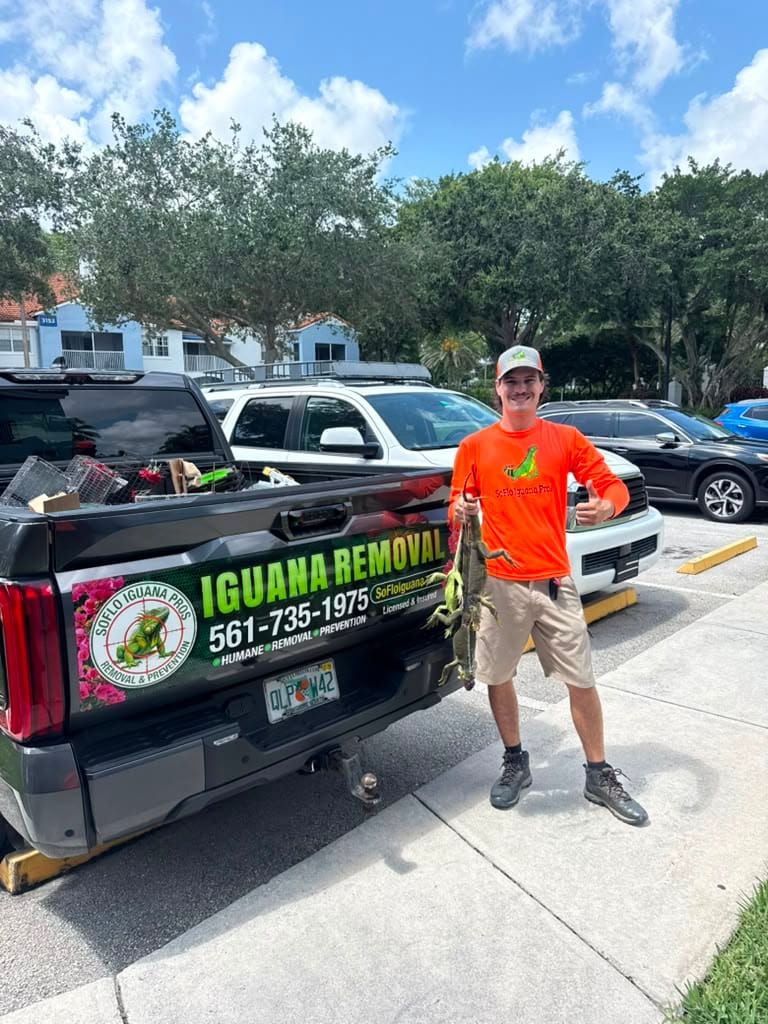

Green iguanas get the headlines, but they're one of several invasive reptiles reshaping South Florida. Here's how the iguana compares — and why it's the one most likely to be your problem.
The green iguana gets most of the attention in South Florida, and for a homeowner it's usually the reptile that matters most — it's the one burrowing into your seawall and grazing your hibiscus. But it's far from the only non-native reptile that's made itself at home here. Understanding where the iguana sits among them helps explain why it's the one you're most likely to actually deal with.
This is a general overview, not a legal or wildlife-authority reference. Rules on non-native reptiles change, so confirm anything binding before you act on it.
Why the iguana is the homeowner's reptile
Of Florida's invasive reptiles, the green iguana is the one that lives on residential and community property in numbers. It concentrates on exactly the places people own and maintain — canal banks, seawalls, lake shores, pool decks, and landscaped beds — and it does structural and cosmetic damage right where you live. That's what separates it from the invasives that mostly stay in the wild: the iguana's habitat overlaps almost perfectly with yours.
The others you hear about
The reptiles that make the news tend to be creatures of the deeper wild rather than the backyard, which is why most homeowners never encounter them directly even though they're a serious ecological story.
- Burmese pythons — the headline invader, concentrated in the Everglades and far more an ecological crisis than a backyard one.
- Tegus — large ground lizards that raid nests and can turn up in neighborhoods near natural areas, but nowhere near iguana numbers on the coast.
- Various non-native geckos and anoles — widespread and visible, but harmless nuisances rather than a damage problem.
- Green iguanas — the one that actually colonizes waterfront and community property in force.
Why the iguana spreads the way it does
The iguana thrives here for the same reasons it's your problem specifically. It's built for the tropics and South Florida's climate suits it, it has almost nothing keeping its numbers in check, and it's a strong climber and swimmer that travels the waterline between properties. A female lays a large clutch of eggs each spring, so a couple of animals on a bank become a colony fast. Put that together and you get an invasive that doesn't stay in a preserve — it moves down the canal from yard to yard.
What that means for your property
The practical upshot is that among Florida's invasive reptiles, the iguana is the one most worth a homeowner's attention and money, because it's the one doing damage on the property line. The pythons and tegus are a real ecological problem, but they aren't the reason your seawall cap is cracking. If you're on the water in Palm Beach County, the invasive reptile to plan around is almost certainly the green iguana — and the plan is the same as always: clear the residents, collapse the burrows, and cut off the climb routes.
Questions we hear
Are iguanas the worst invasive reptile in Florida?
It depends what you mean by worst. Ecologically, the Burmese python in the Everglades is the bigger crisis. But for a homeowner, the green iguana is the one that matters — it colonizes residential and community waterfront in numbers and does structural and landscape damage right on your property, which the wilder invasives don't.
Could a python or tegu show up in my yard?
It's uncommon in most coastal Palm Beach County neighborhoods. Pythons concentrate in the Everglades, and tegus turn up mainly near natural areas. Neither approaches the iguana's numbers on the developed waterfront, so for the typical homeowner the iguana is the realistic concern. This is general information, not a wildlife-authority reference.
Why do iguanas spread so much faster than the others?
Their habitat overlaps ours. They favor canal banks, seawalls, and landscaped waterfront, they climb and swim well enough to travel the waterline between yards, and a female lays a large clutch each spring. That combination turns a couple of animals into a colony and moves them from property to property in a way the wilder invasives don't.
Services in this guide