Every few winters a cold front drops enough to send iguanas tumbling out of the trees. Here's what's happening, and why it isn't the fix it looks like.
If you've lived through a Palm Beach County cold snap, you've seen it — or seen the news alerts for it: iguanas dropping out of trees onto lawns, pool decks, and the occasional windshield. It's real, it's seasonal, and it tells you a lot about the animal you're dealing with.
Iguanas are cold-blooded, so their body temperature tracks the air around them. When temperatures fall into roughly the mid-40s°F and below for a stretch — usually overnight behind a strong front — their systems slow to the point they can't grip the branch they're basking on. They go limp, what people call 'cold-stunned,' and down they come. The bigger the animal and the longer the cold holds, the more of them you'll find on the ground the next morning.
It's worth remembering this is a green iguana, an animal built for the tropics, living well north of where it evolved. South Florida winters are the one time of year the climate pushes back on a species that otherwise has almost nothing keeping its numbers in check here.
A stunned iguana usually isn't a dead iguana
This is the part people get wrong. Most cold-stunned iguanas aren't dead; they're in a kind of suspended animation and revive as the day warms and the sun hits them. That big 'dead' one on your patio at 8 a.m. can be biting and tail-whipping by noon — which is exactly why you shouldn't grab one bare-handed on a cold morning.
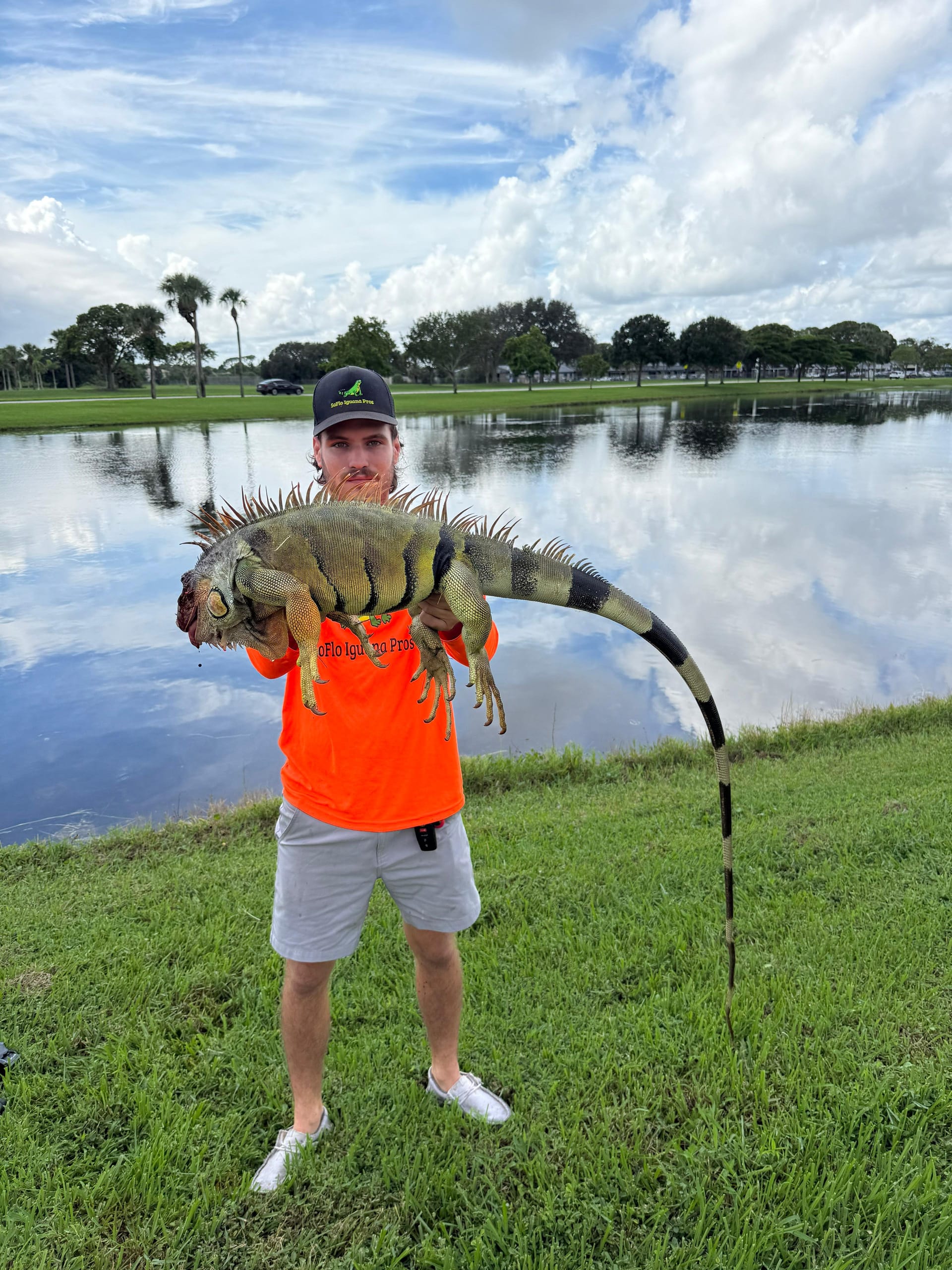
A large male can run five feet nose to tail and carries real muscle in that tail and jaw. Waking up upside down in a stranger's hands is going to trigger a defensive reaction, and a tail whip or a bite from an animal that size draws blood. If one's on your driveway and you need it gone, the safe play is to leave it be until it either moves off on its own or a pair of gloved hands can deal with it.
Why a freeze doesn't solve your iguana problem
A hard cold event can knock a local population back, and after a severe freeze you'll see fewer of them for a while — that part is true. But it's weather, not management. Survivors return with the warmth, and the ones that made it through are often the biggest, best-sheltered adults, exactly the breeders you least want left standing. They pair off and nest through spring, and the numbers climb right back by summer.
There's also a false sense of security that comes after a cold snap. A quiet January bank looks solved, so the property walk gets put off, and then April arrives with fresh burrows along the seawall and nobody having done a thing. If you back up to a canal or a community lake, the smarter read on a freeze is that it bought you a head start, not a finish line.
What we actually get called for after a cold snap
The morning after a freeze is one of our busier stretches, and it's rarely for live removal. It's cleanup and it's planning. Dead-iguana disposal is the first call — a carcass, or a pile of droppings under a favorite basking tree, isn't something you want sitting on a pool deck, and there's a salmonella angle to handling any of it bare-handed.
The second call is the one that actually changes your summer: a property assessment while the pressure is visibly low. When the survivors are still sluggish and the banks are quiet, it's the easiest time of year to map where they were denning, collapse burrows, and get a removal plan in place before nesting season fires up.
- Carcass and dropping cleanup on decks, docks, and lawns, handled with gloves and proper disposal.
- A walk of the seawall, canal bank, or lakeshore to find and mark the burrows the cold exposed.
- A head-start removal and prevention plan aimed at spring, while numbers are naturally down.
- A honest read on whether the freeze thinned your population or just moved it into shelter.
Questions we hear
Should I move a cold-stunned iguana myself?
It's best not to. They revive unpredictably, and a large one can bite or whip its tail hard as it warms and panics — and if it's actually dead, the carcass and droppings can carry salmonella. A quick call gets it handled safely, and we'd rather you not learn the hard way that the 'dead' one on your patio was just cold.
How cold does it have to be for iguanas to fall?
Roughly the mid-40s°F and below, sustained for a while — the exact point varies with the animal's size, how long the cold lasts, and how exposed it is. A quick dip that rebounds by mid-morning drops fewer than a long, still, cloudy cold night.
Will a cold winter fix my iguana problem for good?
No. A freeze can lower the count for a season, but the survivors breed the population right back by summer. Treat a cold snap as a window to get ahead of nesting, not as the solution itself — that's where people lose the ground the weather gave them.
Services in this guide