The C-51 links the Everglades edge to the Lake Worth Lagoon, and iguanas use it as a corridor into Wellington, West Palm, and Lake Worth. Here's how that shapes control.
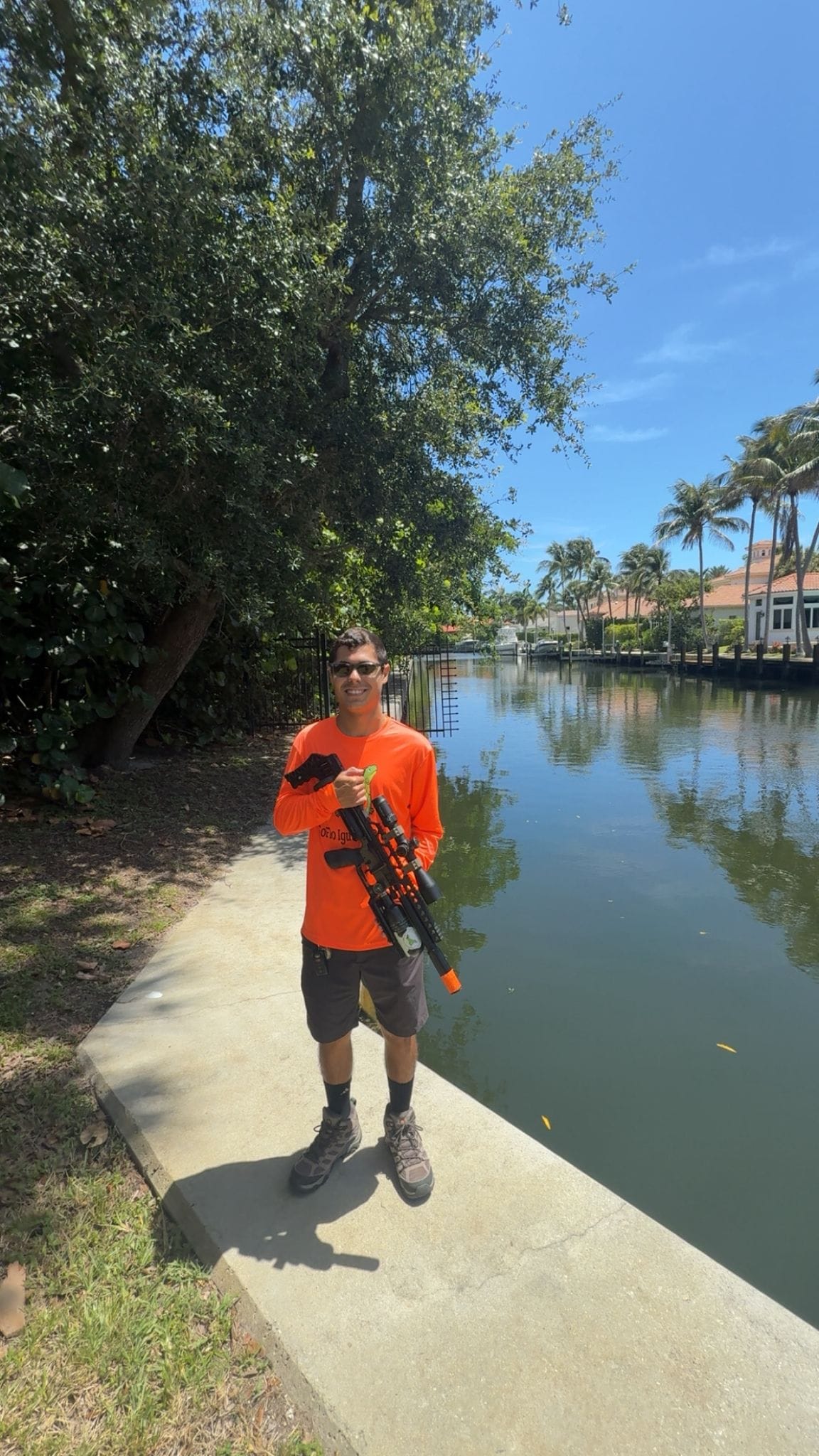
If you want to understand why iguana pressure keeps refilling in the central part of the county, look at the C-51 canal. It's a major drainage canal that runs roughly west to east, tying the western communities and the Everglades edge to the Lake Worth Lagoon at the coast. For iguanas, it's a continuous corridor — soft banks, sun, and water — that moves animals across Wellington, West Palm Beach, and Lake Worth.
A canal like this reframes the whole problem. You're not dealing with a fixed population on your lot; you're dealing with a supply line that keeps delivering. That's not a reason to give up — it's the reason a one-time grab never holds along the C-51 and why prevention on the bank edge matters as much as removal.
Why a drainage canal is ideal habitat
The C-51's banks are exactly what an iguana wants: long stretches of soft, sun-exposed soil sloping down to water, with almost nothing hunting them. They burrow into the banks to den and nest, bask along the edges, and slip into the water at the first sign of trouble. There's no natural check on their numbers here the way there would be in their native range.
Because the canal connects, animals cleared from one property are replaced by others moving down the bank. The canal is essentially a renewable source, which is why properties that back it need ongoing pressure control rather than a single clear-out.
Where the C-51 hits home
The canal and its tributaries put iguanas into a lot of backyards. In Wellington, the C-51 and the community canals off it feed the equestrian estates and the family subdivisions alike — the same corridor that makes paddock-berm burrows a horse hazard. Further east it feeds the West Palm neighborhoods and empties toward the Lake Worth Lagoon, tying the freshwater system to the Intracoastal front.
If your lot backs the C-51 or one of its branch canals, the practical read is that you're on a highway, not a cul-de-sac. Your neighbor's bank and the stretch a mile upstream are part of your problem.
- Bank burrowing that undermines yards, seawalls, and canal-edge structures.
- A continuous supply of new animals moving down the corridor after any clear-out.
- A link between the western communities and the coastal Intracoastal population.
What control looks like on a canal corridor
On the C-51 the plan is clear-then-harden-then-monitor. Remove the residents, collapse and pack the burrows so the bank stops eroding, and harden the waterline edge where they re-dig first. Then keep it monitored — a seasonal re-check to re-pack new diggings and confirm the prevention is holding, because the corridor never stops feeding.
This is the classic case for a program over a one-off. A single visit clears what's there; a monitored program from $99 a month keeps the count down against a supply that doesn't quit. Single visits still start at $125 if you want to knock a bad stretch back and reassess.
It's a shared problem, not just yours
The other thing a canal corridor makes plain is that iguana control on the C-51 works best when the neighbors and the community are in it together. Your cleared bank is only as protected as the stretch upstream, so a single owner fighting a fed corridor alone is always swimming against the current a little.
That's why so much of the canal-adjacent work in Wellington and West Palm ends up being community-scale — an HOA mapping and working the whole bank it maintains rather than one lot at a time. If your association backs the C-51 or a branch canal, treating it as a shared common-area asset is both cheaper and more effective than a patchwork of individual clear-outs, and it's the framing we bring to a board.
Questions we hear
Why do iguanas keep coming back to my canal-front yard?
Because a drainage canal like the C-51 is a continuous corridor — animals cleared from your bank get replaced by others moving down the waterline. That supply is why canal-front lots need ongoing control rather than a single clear-out to actually stay ahead.
Can prevention alone keep iguanas off a canal bank?
Prevention keeps new ones from settling, but it won't clear the ones already denned in your bank — you pair burrow collapse and edge-hardening with removal first. On a fed corridor like the C-51, the two together, kept up seasonally, are what hold.
Is a monthly program really necessary on the canal?
On the C-51 or one of its branch canals, usually yes. The corridor keeps delivering animals, so a program from $99/mo holds the count where a one-time grab just resets it. Inland lots off the water sometimes do fine with a single visit.
Services in this guide