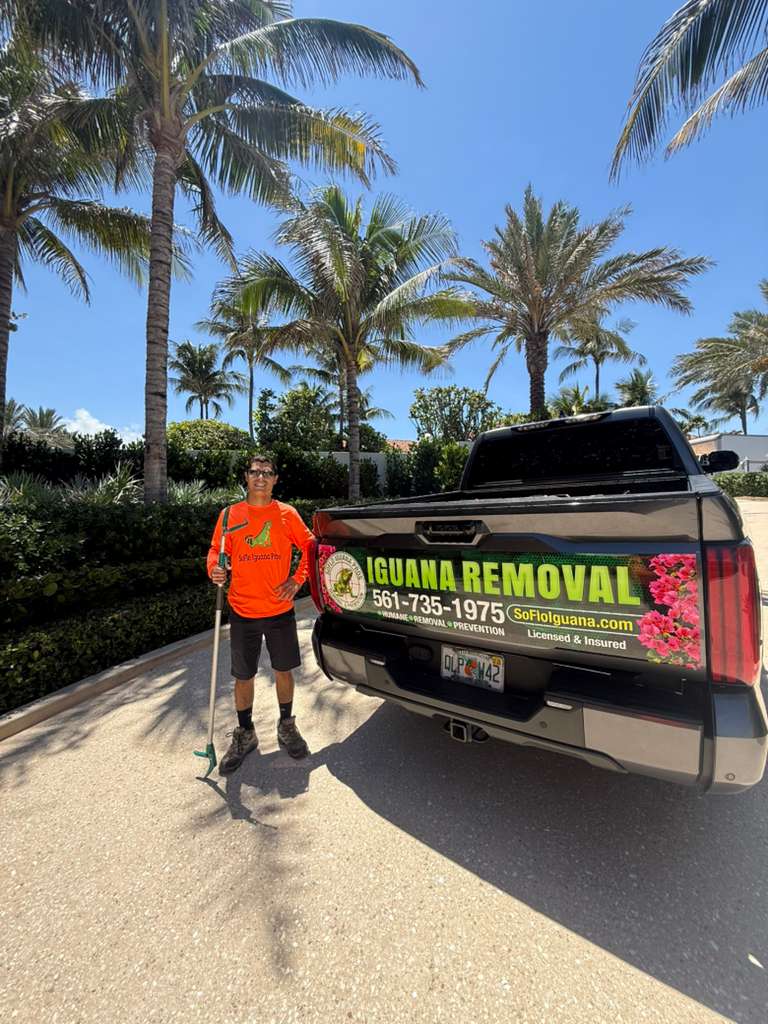

If your board is putting iguana control out to bid, here's what belongs in the RFP so you can compare vendors on the same terms — and avoid the low bid that costs more.
When a board decides to put iguana control out to bid, the quality of the RFP decides the quality of the responses. A vague request — 'remove the iguanas at our community' — gets you a spread of prices that measure completely different things, and the low number usually turns out to be the one that does the least. A tight RFP lets you compare vendors on the same terms.
We respond to community RFPs regularly, and the ones that produce good, comparable bids all share the same handful of elements. Here's what to put in yours.
Define the scope by area, not by animal
Ask vendors to price the areas the association maintains — the lake banks, seawalls and canal edges, amenity decks, clubhouse beds, entrance landscaping — rather than a headcount of iguanas, which nobody can honestly promise. A scope defined by area is one every bidder answers the same way, so their numbers actually line up.
- List the common areas in scope, ideally with a rough map or aerial.
- State what's explicitly out of scope — private lots, for instance — so bids don't quietly differ.
- Ask what each visit includes: removal, trapping, burrow collapse, climb-route prevention.
- Ask for the service cadence and how it flexes for spring nesting season.
Require insurance and documentation up front
Two requirements separate serious vendors from the truck-and-a-net operators, and both protect the board. Require a certificate of insurance naming the association as additional insured — anyone working your common areas should carry it and be able to produce it before the first visit. And require documented reporting: what the vendor logs after each visit and in what form. A board that can't show a paper trail can't defend the line item.
- Certificate of insurance naming the association, provided before work begins.
- A sample of the service report or catch log the vendor provides after each visit.
- A single named point of contact for the property.
- Confirmation that green iguanas are handled within Florida's rules, humanely.
Ask about continuity and lock-in
Two questions tell you a lot about what the relationship will feel like. First: who is my contact, and will it be the same person? A rotating call center handles a community very differently than one accountable local contact. Second: what's the contract term, and can we exit? Some vendors lean on multi-year lock-in. We run programs without it, on custom pricing, because we'd rather earn the renewal — and it's fair to let bidders explain their terms so the board can weigh them.
Weight the bids on more than price
The cheapest bid is almost never the cheapest program. A one-time spray priced low leaves the burrows and re-colonization untouched, and you're back out to bid a year later with a slumping seawall on top of it. Score responses on scope, insurance, documentation, continuity, and terms — not price alone — and the honest comparison usually pays for itself. If it helps, our team at /commercial can walk a board through what a complete response should cover before you finalize the RFP.
Questions we hear
Should the RFP ask vendors to guarantee a number of iguanas removed?
No — no honest vendor can promise a headcount, because pressure refills from adjacent water continuously. Price and compare by area covered and service cadence instead. A guarantee of a specific count is a red flag, not a selling point.
What insurance should we require in the RFP?
At minimum a certificate of insurance naming the association as additional insured, provided before work begins. Anyone working your common areas should carry it and produce it on request. We can supply a COI for review as part of any proposal.
Is the lowest bid usually the best value?
Rarely. A low one-time price often skips burrow collapse and climb-route work, so the population refills and the board is back out to bid within a year — sometimes with new seawall damage. Weighting scope, documentation, and terms against price gives a truer comparison.
Services in this guide